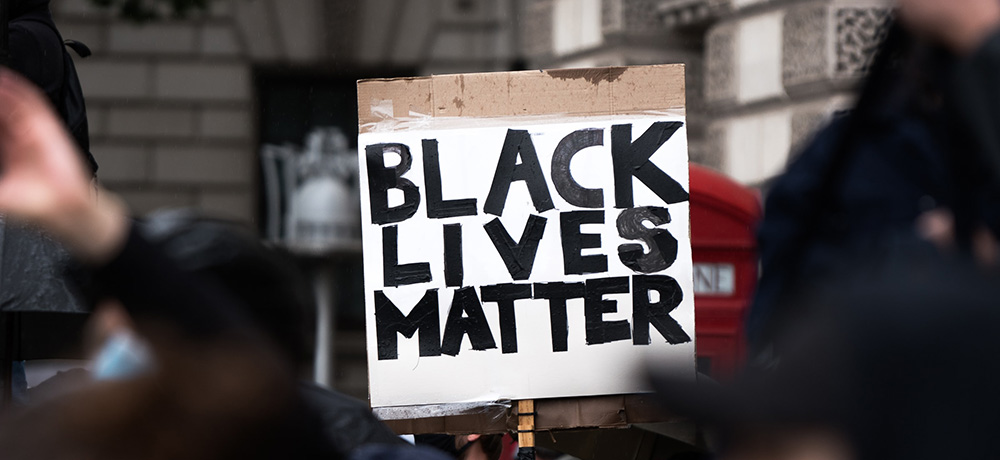
As part of a competition, young people at a supplementary school in Croydon were asked to write about the Black Lives Matter movement. Teachers at the school were amazed at what they wrote.
What does Black Lives Matter mean to me?
Below are the written contributions of Year 3 to Year 10 students at the Croydon Supplementary Education Project (CSEP), in Croydon, Surrey. The students, as part of their English lesson and promoting Pupil Voice, were asked: ‘What does Black Lives Matter mean to you?’ See the bottom of the page for more background on the project.
Responses
Stephanie Conteh Amoah – Year 9
Black lives matter! To me, it has never been a trend or an excuse, it has always been a statement and a campaign to move humanity forwards and better our lives. There is a saying that ‘history repeats itself’ and I choose to believe that Black lives matter, this statement, this philosophy- a way of life for so many people- opposes that saying and here’s why.
Black people have been seen as inferior or uncivilised since the beginning of their ‘discovery’ which led to the slave trade, stripping the rights of black people away from them. Then came the abolition of slavery thanks to many great pioneers and campaigners like Olaudah Equiano, Harriet Tubman, Harriet Jacobs and Fredrick Douglas, to name a few. But soon followed the criminalisation of black people, with loopholes in the law and amendments that made it impossible to be Black in America and free, the south especially and there was a divide between the North and South states of America, those for equality and those for white supremacy, a divide which can still be felt today. Thankfully, the North won, but it was not over as the KKK had their own agenda and terrorised black people. They believed that they had supposedly ‘Christian’ ideologies for killing African Americans and it was increasingly difficult for African Americans to even attend school without facing danger.
But then the case of Brown vs. Board of Education 1954 stated that every child has a right to an education in a safe environment, which paved the way for the Little Rock 9 of Arkansas, USA 1957. And this group were constantly in inevitable danger in such a racist place, that all nine of these African American students needed army soldiers and protection for the national forces from the aggressive mobs. Still Black Lives Mattered! Cases like this led to the diversity and culmination of different colours we can see in our schools today. Acts of courage like this, proved that a Black person could be just as good as a White person, if not better. Then from here Black culture influenced aspects of white culture. Music: hymns, blues, rapping, even clothes and dancing. And now I can have the opportunity to study it in school and outside of school like at CSEP.
Of course, it is evidently clear that there needs to be a reform in the morality of the justice system like with the case of George Floyd, Breonna Taylor, Zahid Mubarek, Christopher Alder, Kingsley Burrell. This hasn’t just happened in the US, here are some examples from those who died at the hands of police brutality in the UK: Roger Sylvester, Joy Gardener, Smiley Culture, Mzee Mohammad, Trevor Smith, Sarah Reed and more. I strongly believe that their lives mattered and still do.
Black lives matter and while all minority groups deserve fair representation, I feel that Black people have a deepened history with British treatment, Colonisation and the creation of Caribbean culture and their ancestry, all of which lead to present day.
I have seen and experienced varied views on racism in different environments from church to school, both public and private places. And I feel more awareness of BLM should be raised in public places like schools for all ages, so that no single minority feels targeted of or unsafe at any stage in their academic and personal development.
Black Lives Matter will never die or fade away like the memory of those we have lost, but will continue to serve as a reminder that we are all human and deserving of the same rights and opportunities despite our race, ethnicity, nationality or background. Because we are people as well, unbroken by the systemic chains that continue to bound people’s minds today.
Black lives matter!
Myles Yanderpuye – Year 3
What does Black Lives Matter mean to me?
I think that it means that Black lives matter too, and all people should be treated fairly.
George Floyd wasn’t treated fairly. He was killed for nothing. He was just walking out of the shop when it happened.
Black lives matter because Black people should be treated fairly and equally, but they’re not. I don’t know why, but if it’s because of their skin, that’s not fair. You shouldn’t judge someone on how they look or their skin tone.
Keziah Dixon, Year 4 – 9-years-old
What Does Black Lives Matter mean to me?
Black Lives Matter because although slavery times have passed, the colour of our skin makes us second place. So, people have finally stood up for the Black community and tried to make a change for them.
On 25th May 2020, I saw that Derek Chauvin had his knee on George Floyd’s [neck] while under arrest. He put his knee on his neck for nearly nine minutes while George Floyd was saying, ‘I can’t breathe’. By the time the ambulance came he had died. I felt shocked because a White police officer thought that he could kill innocent people and get away with it. That shows how racist our world is, although the Black community have stood up for each other. Even White people have been protesting. Why? because they saw that this wasn’t right.
Paige Bassy-Lucien – Year 3
What does Black Lives Matter mean to me?
It means we look after Black people. We should wear our t-shirts to represent Black people.
George Floyd
I think the police should have listened to the people. George Floyd said, “I can’t breathe.” But the police officer did not listen. He died.
Cazai Collu – Year 4 – 8-years-old
What does Black Lives Matter mean to me?
It might mean to me that Black History Month is important, because we can learn more knowledge about our ancestors. Also, Black History is good for you because we can hear Black voices from the whole world. George Floyd died on 25 May 2020. A White policeman put his knee on his neck for about nine minutes. I felt sad because the policeman wasn’t doing his job. It wasn’t necessary to do that.
Adjoa Abboah-Offei – Year 9
What does Black Lives Matter BLM mean to me?
Black Lives Matter (BLM) is an organisation that was created by Alicia Garza, Patrisse Cullors and Opal Tometi in 2013 to support and bring light to Black people who were killed or treated unlawfully, particularly by the police force and the (criminal) justice system.
BLM has helped many victims of police brutality to get justice. A most recent example of this would be George Floyd’s [family] who was killed on May 25th 2020, in Minnesota by a police officer called Derek Chauvin. This murder was filmed by a 17-year-old who was with her cousin and others. I find the fact that two Black children had to watch someone of their own community getting murdered disturbing. Ms Frazier was relentlessly cyber-bullied on social media after not ‘stepping in to help’. After this, as witnesses, they had to testify in court. Derek Chauvin has been recently found guilty of manslaughter and 2nd degree murder. After this charge, the streets of Minnesota were filled with joy, however, a sign was put up with the words ‘justice served?’ on it. For me, this felt particularly poignant as it has a deep meaning. Of course, Chauvin has been convicted, which is great, however George Floyd is still dead, and there are many other victims of police brutality. The organisation BLM was also prominent in 2014 after the killing of Eric Garner in New York.
To me, BLM is extremely important as it means a lot to have a community of your own people who support you. BLM is long awaited progress after Black people have been historically oppressed and discriminated against for decades. BLM is an important pillar of our society, especially for the Black community.
Rasharn Allen – Year 10
What does Black Lives Matter mean to me?
Black Lives Matter began as a hashtag by three women. They set it up, so there could be no leadership structure, hence building a social community with no set leader. It was inspired by police violence against the Black community [in the USA].
Black Lives Matter is a movement created to assist in forwarding racial equality, not just for Black Britons or African Americans, but Black people globally. Millions protested after the death of George Floyd.
This movement further showcases the poor treatment of Black people through racism, hate crime, police violence etc.
As good as the movement is, it can fuel much more hate and end possible extremism through Black Lives Matter’s members and haters.
A trend called ‘All Lives Matter,’ was made to belittle and attack the Black Lives Matter movements by spreading false evidence, and making its members believe false ideologies. Gaslighting, is essentially shooting others’ opinions, no matter what they say.
In conclusion Black Lives Matter is a movement created for ALL to support racial injustice and to forward peace and equality. I think the movement is for the best.
Rossi French – Year 10
What does Black Lives Matter mean to me?
‘Black Lives Matter’ is a movement that has once again given attention to the topic of racism. Yet, this movement has an even deeper meaning that is displayed through its wording, saying that Black people ‘matter’.
This is referencing the historical context that during periods of racism, the lives of ‘coloured’ people were seen to worth less than those of Caucasian heritage. A prime example is the Trans-Atlantic Slave Trade, where Black [people] were enslaved and treated like livestock rather than with human decency.
So, the movement’s only motive is to justify Black people’s existence within mainstream society because the past has deeply affected those of Black heritage, this is due to them hearing about their ancestors suffering during times like the slave trade. Therefore, the movement is about making people aware that their lives have value and so does every life that is Black. Examples like George Floyd, which show a blatant disregard for Black life are the reason why this movement is important today.
This movement serves as a step forward on the journey to climb the mountain of equality. It helps to promote the message that Black lives have value and it does bring results. For example, this movement helped George Floyd’s family to be compensated and they have been able to go to the White House. Black Lives Matter is an initial step that must be crossed, so that we may strive for equality and justify the sacrifices of those before us.
Amani McKenzie – Year 10
What does Black Lives Matter mean to me?
Black Lives Matter has been a protest that has bought awareness to the many lives lost due to racial attacks; and, the many lives continuing to be lost by racism.
Fortunately, for me, I haven’t experienced any blatant racism towards me. However, there has been racism around me for the past two years. Firstly, on the news and media during the protests of the many Black lives taken unjustly. Such as, the death of George Floyd and Breanna Taylor.
Viewing this from the perspective of an adolescent Black boy (from London), gave me a sense of ambition to prevail against any obstacle that racism has created against me and my people.
Later on, I experienced racism in my school by a Caucasian pupil. This pupil was accused of having racist stances on how people should be able to listen and sing to music. However, I chose not to involve myself with the situation, as I didn’t know the full story and whether the accusations were true or false.
Overall, I believe the experiences I have had and the stories about racism I have seen, have shaped my view and stance on Black Lives Matter. That it has been crucial in paying attention to one of the biggest problems in previous and today’s age; racism.
Kemanee Parris-Bernard – Year 7
What does Black Lives Matter mean to me?
The Black Lives Matter (BLM) movement made me self-conscious about what some police officers can do.
The protest about George Floyd got my attention because, so many people were fighting for Black lives. It was good to see something other than gangs, fires and death.
Michelle Amoah – Year 7
What does Black Lives Matter mean to me?
There was an incident which happened before involving George Floyd, involving a young Black woman named Breonna Taylor, a Black medical worker who is now unfortunately deceased.
It was late at night and Breonna was in her house with her boyfriend with the front door locked shut. That is until it was broken down by members of the police force. They, I assume, worked near her area. Without a warrant, or warning, the police barged into her house. This I believe was uncalled for.
After hearing about the heart-wrenching deaths of George Floyd and Breonna Taylor, it has made me more aware of racism and how many more innocent people have died from it.
Barak Bruce – Year 7
What does Black Lives Matter mean to me?
I first heard of Black Lives Matter in May 2020 while I was at home doing homework. I heard the news saying that there would be a protest in London and all over England against police brutality toward people of colour.
I thought it wasn’t a very good idea – I thought change was needed, but this wasn’t the way to achieve it. I went back to my work, but after a while I begrudgingly looked up at the television screen.
I saw thousands, no tens of thousands of people ,all joining together, people of all races. I then had a thought that it just might work.
The Black Lives Matter movement spread like wildfire. From people on social media making their profile pictures blacked out, to multiple companies saying things like, ‘we have no place for racists’. One of the biggest gestures made being that footballers who ‘took a knee,’ before matches, showing their support for the Black Lives Matter movement.
Jaiden Francis-Caesar – Year 8
What does Black Lives Matter mean to me?
Black Lives Matter is a group of people who stood up for Black people, and Black Lives Matter is a protest to stop racism. But some people don’t like Black people standing up for themselves. About a year ago, an African American died with a White police officer’s knee on his neck for nine minutes and it was caught on camera. The officer was sent to jail for 22 years.
George Floyd’s death woke people up and they decided to protest it worldwide. George Floyd’s funeral was on the television all around the world.
Nia Kamale – Year 10
What does Black Lives Matter mean to me?
Black Lives Matter is a very important movement to me. Growing up I have always been aware of the racism that my people have had to put up with for centuries. I have also had teachings on the ways that higher authorities such as the government and the police have treated my people. I also know that for decades my ancestors were abused and tortured. They fought for their freedom and eventually they got it, but it took blood, sweat and tears to get it.
After the Trans-Atlantic slave trade was ended, there were still many Black people enslaved. Even after my people were free, they were still experiencing prejudice everywhere they turned.
Take the murder of Trayvon Martin for example. He was a young boy who was shot by a White man whilst walking out of a shop. Again, George Floyd; he was brutally murdered by a policeman. These tragic events still occur today. My kind are still suffering.
So yes, back to the question. Black Lives Matter is a movement that is trying to change the way our people have been, and still are, being treated. Although we cannot change the trauma we have experienced, we can try to change the way the authorities treat us, by protesting, petitioning, writing letters to the government to try to get a bill passed. So, we can make our lives safer for the present and for the future.
Nakeba Duffus – Year 7
What does Black Lives Matter mean to me?
To me, Black Lives Matter (BLM) means that Black people are just as important as any other race and should be treated fairly. When I first heard and was curious about Black Lives Matter, was when George Floyd’s death by police was all over the news and media. As a result of this, the public began to protest on the streets all over the world.
Protests:
Protests took place all over the country and all over the world. People of all different races would bring signs or flags and protest on the streets. People protested for justice and for Black people to be treated fairly by racist people, police officers, discrimination and other reasons.
Police:
People believe that some police officers treat Black people unfairly. An example is George Floyd’s death. He was killed by a police officer. In videos and pictures on social media, it proves that some police officers often use unnecessary violence towards Black people.
Racism:
Some people can be racist by making fun of appearance/race or culture of another race. Racist police officers take advantage of their power and show violence to Black people and other people of colour.
Background to the writing
From the 1960s to 1980s, several Supplementary Schools were established in the United Kingdom by Black parents who were dissatisfied with the underachievement of their children in the British school’s system.
The Croydon Supplementary Education Project (CSEP) was set up, from the frustration of seeing pupils, mainly Black children, underachieving in mainstream state schools. Parents, community activists and concerned citizens saw this as a concern for their community, and decided action needed to be taken.
 CSEP was established in 1982, by the founders Mr Andy Johnson MBE and the co-founder Mrs Cynthia Graham. CSEP is still running today; it has had several managers since its inception and has progressed to become a community hub offering several services.
Our Saturday school works to develop competence and excellence in the core subjects of the National Curriculum (English, Maths and Science). Black history is taught as a subject from at Key stage 3. However, it is also embedded into the Key stage 1 and Key stage 2 curriculum.
CSEP provides help and support to young people from Key stage 1 – Key stage 4, in terms of study skills, revision techniques, help with mainstream school topics and projects.
Support is provided by a dedicated team of qualified teachers, teaching assistants, peer mentors, administration staff and volunteers. We help each student towards achieving his or her academic potential through small class sizes and group work.
At CSEP, as part of our English lesson and promoting Pupil Voice, the children were asked:
‘What does Black Lives Matter mean to you?’
Most of the children said they had not discussed this in their school lessons, but they were aware of the issues from the news and social media. But had anyone stopped to ask the children?
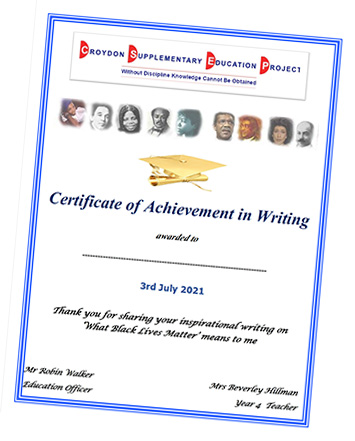
We were amazed at what they wrote (independently), from Year 3 to Year 10. This then became a writing competition with certificates and prizes for the best writing. Stephanie Conteh Amoah and Nakeba Duffus, were selected by the teachers for the best pieces of writing. These two girls were given certificates and a signed book by Robin Walker, the noted historian. All the children received a certificate for their participation.
The work has been typed up, so others can read it, but not edited beyond the meaning of the child’s original work.
For more information on the Croydon Supplementary Education Project please see https://www.csep.org.uk.
Beverley Hillman


