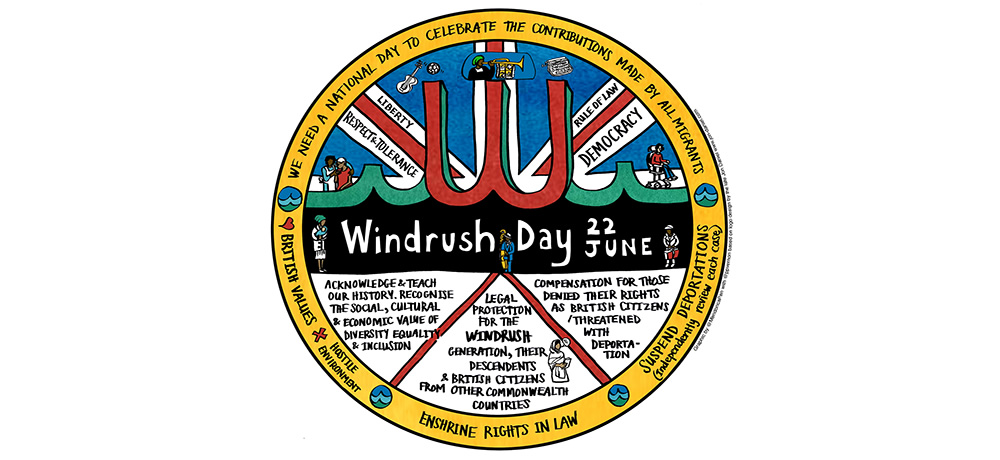
Graphic facilitation by www.penmendonca.com @MendoncaPen, in collaboration with Windrush campaigner @ppvernon
Patrick Vernon describes the need to include Windrush stories in our public imagination of how modern Britain was built.
After several years of campaigning with many faith leaders, activists, trade unions, politicians, celebrities, community organisations and individuals for a national Windrush Day (I personally wanted a public holiday) it is great that the government has finally recognised this on the 70th anniversary of the MV Windrush.
One of the positive consequences of the recent Windrush Scandal has been a massive media and public history lesson on the arrival of MV Empire Windrush at Tilbury Docks on the 22nd of June 1948, and the subsequent contribution of the Windrush Generation to Britain over the last 70 years.
Sadly, the public have learned more about Windrush during the month of April 2018 than in the previous 50 years. This in many ways reflects a failure: how this country and key public and private bodies have not engaged with this narrative in dialogue, and in partnership with the Windrush Generation and the wider context of the migration contribution to Britain.
That is why the government have conceded to the idea that Britain needs a Windrush Day to celebrate the contribution of the Windrush Generation, three generation of Black Britons.
It is disappointing that the announcement by the government did not recognise the symbolism that Windrush Day could have to recognise the wider contribution of all migrants, especially in the context of a hostile immigration environment. I hope Theresa May will now also consider that if we have a Windrush Day then we can now abolish the hostile immigration policy which will taint and jar with celebrating the Windrush Generation and migration.
This raises the outstanding issues and fallout of the Windrush scandal which need to be resolved if Windrush Day is to become authentic and valued by everyone. The government needs to clear legislation to protect the children of the Windrush Generation and a compensation scheme for the victims which reflects the sprit and values of restorative justice. The government also needs a plan of action to bring back those who have been deported and those left stranded in the Caribbean and elsewhere around the world because they have been refused entry over the last decade.
I also welcome the government’s proposed Windrush Fund to support local and regional initiatives in promoting Windrush legacy. I hope that the £500k is ring fenced and binds future governments as we all know that austerity has hit the BME voluntary and community sector hard since 2010. The government should also have a separate strategy to provide core funding to organisations like Black Cultural Archives, Stephen Lawrence Trust, Bernie Grant Centre, Windrush Foundation, Migration Museum, and the many regional and community organisations outside London. I hope the Windrush Fund supports and promotes the hidden voices of Windrush around women, young people and sexuality, if they want Windrush Day to be inclusive.
The challenge for the government and for many of us who have been campaigning for Windrush Day is how this becomes part of the national narrative and public memory of Britain.
I think we require the following actions, to which the government can provide leadership and support: the Royal Mail could issue a series of commemorative stamps, while the Royal Mint and the Bank of England could issue special coins or bank notes. The government, with private sector sponsorship, should commission a statute or permanent monument to celebrate the Windrush Generation. Support should be given to the development of a national oral history and intergenerational programme to capture personal histories of the Windrush Generation and other BME elders, the publication of educational and learning resources around migration and diversity, and a social media campaign to celebration the contribution of migrants to Britain.
It is critical that the Windrush Generation and other migration histories should be part of the national curriculum on the same status and footing as the teaching of the Holocaust so that future generations understand and learn the importance of cultural diversity and tolerance.
Whatever the idea, we need a permanent marker for Windrush, especially as we move towards a post-Brexit Britain. The 70th anniversary is a chance to reach across our many different ethnic, faith and family heritages, to reject prejudice and intolerance, and to shape a fair and inclusive future that we all want to share.
A national Windrush Day on the 22nd of June every year is a good starting platform, but we must ensure that the public memory of the Windrush Generation and other migrant communities are part of British DNA – otherwise we will still have ongoing political scandals affecting other migrant communities in Britain.
With the government supporting a national Windrush Day it is now time for other public and private bodies to acknowledge the Windrush Generation and migration.
This article was first published on Media Diversified. Windrush Day graphic (top) was produced in April 2018, before the UK government recognised Windrush Day.


