Christine Elliott, CTBI’s former Director of International Programmes, reports on a visit to the National Christian Council of Sri Lanka (NCCSL) prior to leaving CTBI earlier this year.
‘If Christ be for us who can be against us?’ said the Revd Maxwell Doss, the new General Secretary of the National Christian Council of Sri Lanka (NCCSL), as he opened the meeting of the Council’s partners in Colombo. He went on, ‘We meet at a time of increasing hopelessness and militarism in Sri Lanka which is shrinking the space for building peace and reconciliation.’
I was representing CTBI at this meeting of international partners, because we are working with NCCSL on a five-year programme about land justice and reconciliation. Maxwell continued, ‘We need a spirituality of reconciliation. Reconciliation is a way of living that leads to healing, which demands forgiveness and truth-telling.’

The CTBI programme addresses the heart of this, the General Secretary’s primary, current concern and the focus of the meeting was on the contemporary political and social conditions in Sri Lanka and the churches’ response. We met at a time of increasing helplessness in the country and yet we were challenged and stimulated to think beyond our own imaginations.
Before the meeting we spent three days visiting NCCSL work near Hatton in the tea plantations area, in the town of Ampara where inter-religious tension has been particularly tense and Batticaloa where Zion Church was destroyed by a bomb in the Easter attacks last year.
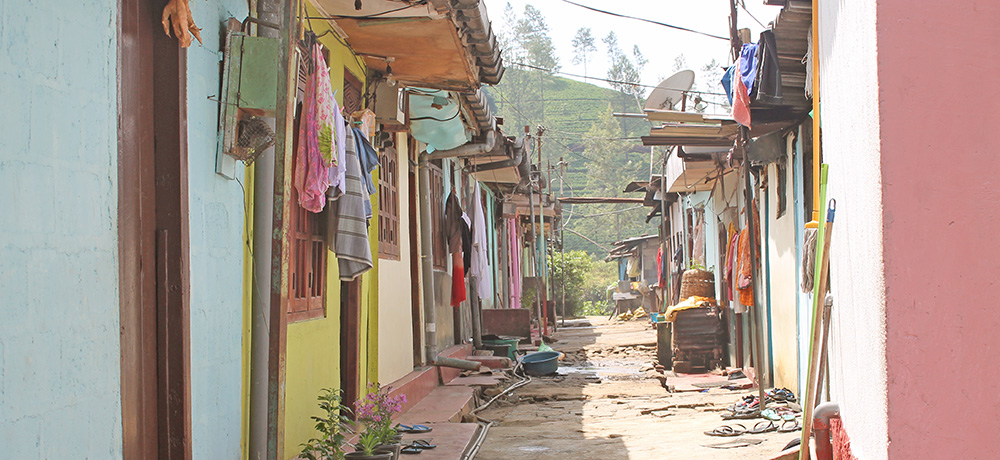
The hilly tea gardens are a beautiful sight. Behind the beauty are many stories of hardship. Many people’s livelihoods depend on very hard work for meagre reward. Most tea pickers are women and if they manage to pick at least 16kg of leaves in a day they will receive a daily rate, which is just over £3. Of course, they are not able to pick every day, some days there is no tea to pick and sometimes they are too ill to work. Houses are provided by the estate owners, they are small, often old and poorly maintained. There is a real need for water and sanitation projects. A recent NCCSL ‘Tea Day’ was a great celebration of local Tamil culture and deeply affirming for many people we talked to.
In Batticaloa we met with ten Christian clergy, nine Muslim leaders, three Hindus and three women from civil society organisations in a very open exchange about the situation. One of the imams recounted a conversation he had had with his son. He told him that two men had bombed Zion Church in Batticaloa and their violence changed everyone’s perception of Islam, now your task is to use love to show everyone that Islam is a religion of peace.
The deep and meaningful conversation was a challenge to us all about how we are too often too quick to think the worst about a situation and yet we are called to be witnesses to God’s perfect love which casts out all fear.
We also met a group of 10 former combatants. All had taken part in ‘Healing of Memories’ workshops run by NCCSL. All felt that it had helped them to heal their feelings of hostility and resentment. They had also received help to find a new livelihood and a secure place within a community formerly divided by religion and ethnicity; we heard of two people starting small grocery shops, one had bought a cow, one had set up a small poultry farm, one had set up a breakfast food stall and one was making snacks at home to sell locally.
The visits and meeting were humbling and inspiring, I am full of admiration and deep gratitude to NCCSL staff for what they do.
Some other NCCSL highlights:
- Inter-religious dialogue and networking included programmes after Buddhist-Muslim violence in Kandy and children’s events in Mannar.
- Healing of Memories work included workshops, training and reunions and also, for the first time, a one-day programme at a Buddhist university.
- After the Easter bombings Muslims faced a lot of hostility. NCCSL enabled dialogue to mitigate violence, understand coexisting and promote healing.
- Healing Through Art and Drama workshops were held with orphans who had suffered abuse.
- Work with farmers, plantation communities and ex-combatants to enhance their dignity and security through livelihood training and organisation for land rights.
- Two booklets, “Strengthening Christian Unity, Joint Witness and Ecumenical Relationships” and “Witness in a Multi-Religious Country and Strengthening Inter-Religious Relations.”
- Regional church councils, ecumenical lectionaries, liturgies and hymn books.
- Symposia for young clergy on ecumenism.
- NCCSL challenges member churches to work ecumenically rather have denominational programmes.


