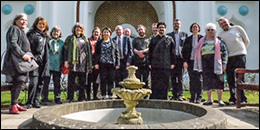
 ‘What contribution can those involved in the inter-religious work of the churches offer in the current challenges faced in Europe at the present time?’ This was the primary question addressed by the group, mainly comprised of people working as interreligious officers for various churches in Europe and church related organisations, who met at St Columba’s House, Woking, UK, 29-31 March 2017.
The meeting was jointly organised by the Interreligious Office of the World Council of Churches, Churches Together in Britain and Ireland, and the Conference of European Churches. A particular focus at the meeting was on the challenges offered by the current widescale migration and increased political polarization in Europe, Islamophobia, antisemitism and racism and the interreligious implications they presented.
Those present were grateful to Ms Doris Peschke, General Secretary of the Churches Commission for Migrants in Europe, who shared with the group recent work that had been done by the Commission. In particular she drew attention to the 2016 conference held in Lunteren, with the title ‘Have no Fear’. Facing fears was a significant concern for many in Europe at the present time. The group acknowledged the positive response made by many churches and other faith communities and the need for further theological reflection on questions which took account of the human realities, potentials and complexities of both refugees and those who received them.
In the course of the meeting the group made a visit to Shah Jahan mosque in Woking, the oldest purpose built mosque in the United Kingdom, and were grateful for the hospitality with which they were received there.
Outcomes from the meeting included the hope that there will be a workshop on European inter-religious concerns at the June 2018 CEC Assembly in Novi Sad, and the intention to work towards a conference to be held later in 2018 which would explore the interreligious aspects of migration from both practical theological perspectives. It was also agreed that it would be helpful to create at least an informal network of those working within churches on inter-religious issues.


