Day One

Photo: Christian Aid
The Caribbean Council of Churches has been involved in advocacy to challenge those nations that are restricting or stripping Haitians of citizenship rights.
This is Milciades Yam, he lives in the Dominican Republic and has struggled for many years to get full recognition as a Dominican citizen.
He is of Haitian descent, and this means that the authorities tie the process of getting access to his documents with red tape.
In Dominican Republic you need a copy of your birth certificate each time you get a new job, or renew your ID card, and Milciades has lost count of the number of times he has applied for a new copy.
Now he is working to challenge this issue alongside Christian Aid partner Jesuit Refugee Service, who are fighting for changes to be made to the law.
In his spare time Milciades volunteers at a local school, saying “The children have so few resources, and I see them as brothers and sisters. They are of Haitian descent, just like me.”
To inspire and encourage
‘Let us take time to recognize and draw inspiration from these ordinary people who have shown such extraordinary courage – the world’s millions of refugees and displaced.’- Antonio Guterres, U.N. High Commissioner for Refugees on World Refugee Day (source)
Congolese refugee Menes La Plume is on a mission to change the way refugees are seen across the world. To this end, for the second year running, he has brought electric guitar riffs, drummers and dancers to the Dzaleka refugee camp in Malawi, which was set up in the wake of the Rwandan genocide and is now home to 20,000 residents. The Tumaini (‘hope’ in Swahili) arts festival 2015 put on acts from Malawi, Burundi and the Democratic Republic of Congo. ‘No-one sets out permanently to leave the place they were born. And to then go to a foreign country where they will know no-one,’ La Plume told the Guardian’s Clyde Macfarlane. ‘Who chooses to be looked at as a lesser human being?’ (source)
We are not myths of the past, ruins in the jungle, or zoos. We are people and we want to be respected, not to be victims of intolerance and racism. — Rigoberta Menchú, Guatemala Nobel Peace Prize Winner, 1992 (source)
Ten ways to help refugees:
- Campaign for refugee rights
- Donate or fundraise for refugees
- Welcome refugees to your community
- Amplify refugee voices
- Get the facts about refugees
- Donate clothing or goods
- Volunteer with refugees
- Find out about hosting
- Help resettle refugees
- Find out more
(source)
You can also use the Help Refugees tool from the Gov.uk website to offer help to refugees in your local area. You’ll be asked what help you can offer, such as housing, fostering or donations of goods like clothes and toys.
Day two
Reformed Churches in the Caribbean have joined with the Council for World Mission and the Caribbean and North American Council for Mission to educate Christian communities to end the scourge of human trafficking.
The story of Sanlaap

Photo: Christian Aid
Sanlaap is one of the leading organisations in India working towards eliminating the exploitation of women and children in prostitution and trafficking. Established in 1987, Sanlaap’s pioneering work has enabled them to influence policy in the South Asia region.
Sanlaap works with victims from rescue to reintegration through stages that include psychosocial rehabilitation and socio-economic reintegration. It also campaigns publicly for the rights of these women and children.
This photo was taken in the Sneha shelter, Sneha (lit. ‘Affection’) was started to address the primary need expressed by the women in prostitution when SANLAAP started working with them – ‘protection of their girl children from the violence of prostitution which they experienced day in and day out for want of a place to go – a secure and safe shelter’. Sneha houses more than 150 girls who are rescued girl children from commercial sexual exploitation, girl children of women in prostitution. Sneha is not just a Shelter Home wherein children are provided with basic education and facilities of food and accommodation. Sneha is a complex inter-related multi-disciplinary psychosocial and economic rehabilitation programme in itself. Find out more from www.sanlaap.org.
Organise a meeting between the churches in your area and invite a speaker from an anti-trafficking organisation to come along to inform, educate and inspire you to take action together against human trafficking.
Campaign organisations that are working to end human trafficking include:
- Antislavery International
- Anti-Trafficking Alliance
- Human Trafficking Foundation
- Stop the Traffik
Additional resources
The Council’s project on migration and social justice aims to engage and challenge the churches in their work with migrants, including refugees, internally displaced people and victims of trafficking, and to develop advocacy strategies on migration and racism.
To be Silent is to be Unfaithful (PDF)
A resource pack from the Church of Scotland contains information, discussion topics and worship material which can help individuals and groups to understand and respond to the issues of ‘Human Trafficking’.
Day three
Many Christian churches in the Caribbean share a concern about the issue of pornography, especially via the internet.
Information about pornography addiction support groups in your churches:
Several organisations run support groups in the UK – some set up here, and some are UK branches of organisations in the USA. Either way it’s good to do some homework before choosing a group. Visit the Care website to find out more.
Online support groups can be found here:
- https://www.xxxchurch.com/
- https://mypilgrimage.com/
(CTBI do not take responsibility for website content.)
Explore and discuss in your church small group or bible study group where bodies can be viewed positively and holistically in our culture, e.g. art galleries. You could read a book together to explore a positive perspective on how to view the body. e.g. Body by Paula Gooder.
Day four
Within the Caribbean, violence is a problem to which the churches are called to respond.
The story behind the holiday images of the Caribbean
Early one Sunday in January 2017, a group of women arrived at a church in the rolling, green hills of rural Jamaica. They were not there to worship, but to show support for a young victim of sexual abuse: a 15-year-old girl, who had allegedly been raped by the church’s pastor a few weeks earlier.
The 14 activists entered the church and sat in silence, but angry words broke out when they were approached by a different pastor; the confrontation culminated with him being struck in the head by a tambourine.
The incident marked the beginnings of the Tambourine Army, a new organisation to fight gender-based violence in Jamaica. In January they held what is believed to be the largest-ever protest against gender-based violence in the region, similar marches will be held in solidarity with another group called #lifeinleggings in Barbados, Trinidad and Tobago, Antigua and Barbuda, Dominica, the Bahamas and Guyana.
The Caribbean has among the highest rates of sexual assault in the world: according to United Nations statistics from 2015, one in three women have experienced sexual or physical violence at least once in their lives. And it is estimated that 14-38% of women have experienced intimate partner violence at least once.
“We want to change the culture we have of assigning blame and shame to survivors,” says Latoya Nugent, co-founder of the Tambourine Army. “We want to place it at the feet of perpetrators and change the current narrative.”
(source)
Contact your nearest Women’s Aid to find out what supplies they currently need and organise a joint collection between churches in your area.
Wear black on Thursdays in solidarity with victims of rape and domestic violence. Thursdays in Black encourages everyone, men and women, to wear black every Thursday. This can be a campaign T-shirt, other black clothing or simply a campaign badge as a sign of their support. Wearing black on Thursdays shows others that you are tired of putting up with violence, and calls for communities where we can all walk safely without fear; fear of being beaten up, fear of being verbally abused, fear of being raped, fear of discrimination. The campaign is not confined only to countries at war, but recognizes that violence takes many forms, including domestic violence, sexual assault, rape, incest, murder, female infanticide, genital mutilation, sexual harassment, discrimination and sex trafficking. Thursdays in Black focuses on ways that individuals can challenge attitudes that cause rape and violence, on a personal and public level. It provides an opportunity for people to become part of a worldwide movement which enables the despair, pain and anger about rape and other forms of violence to be transformed into political action.
Find out more at Thursdays in Black
Day Five
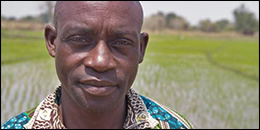 The Caribbean Conference of Churches has launched an initiative to address the current debt crisis in the region and through their international networks to come to the aid of the poor.
Caught in a cycle of debt, repaying loans for seeds and fertilizers with the rice he harvested Boniface (pictured) could never dream of starting a business in the Karonga area of Malawi where he lives. But now he is part of a village savings and loans scheme where he and his neighbours put their money together for 5 months. They can borrow and repay and everyone in the group benefits from the interest they make. At the end of the 5 month cycle they have their own savings to buy the seeds they need. With additional training Boniface has been able to double his yield ‘This is the best harvest I have ever had’. And soon he will open his own grocery shop
Jubilee Debt Campaign
Jubilee Debt Campaign is part of a global movement demanding freedom from the slavery of unjust debts and a new financial system that puts people first. Inspired by the ancient concept of ‘jubilee’, the campaign works for a world where debt is no longer used as a form of power by which the rich exploit the poor. Freedom from debt slavery is a necessary step towards a world in which our common resources are used to realise equality, justice and human dignity. Find out more and take action at http://jubileedebt.org.uk
Day Six
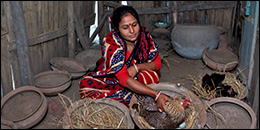 The Churches in the Caribbean introduced the Credit Union movement in order for the poor to have access to finance for economic activity.
Shima Baroi started married life without anything except just a small house, a bed with one pillow since she got married without permission of her parents so they disagreed to help her and her husband start their new life.
Shima rearing ducks and chickens, when she had a few Hens then she started natural process of producing chicken and duck from egg and sell the chickens and ducks in market. She took a loan from the Cooperative Credit Union and Grameen Bank to start a pond renovation and a fish farm and to purchase land to grow paddy rice, Vegetables, spices and took lease some land for culture different types of local/deshi fish as because this has a huge demand in market. She now also has 2 cows which are producing about 10-12KG milk per day. Micro-credit has changed her life.
Churches Mutual Credit Union CMCU is a mutual society, a savings and loans co-operative owned and controlled by its members. It was formed in collaboration by the Church of England, the Church of Scotland, the Methodist Church of Great Britain, the Church in Wales and the Scottish Episcopal Church.
It is run by a small but professional staff and governed by a volunteer board, which includes accountants, clergy, former regulators and experienced businessmen and women drawn from the participating denominations.
In July 2016 the Credit Union extend its common bond to include eligible members of the United Reformed Church. From January 2017 the common bond has been extended further to include eligible members of the Catholic Churches in England & Wales and in Scotland.
Since the launch CMCU has processed 1000 applications from individuals and a further 43 from corporate bodies such as churches and dioceses.
You can find out more at http://cmcu.org.uk.
Day Seven
The churches of the Caribbean are working to give support to both nuclear and extended families.
Ideas of how you might best support families in your area and across the world:
Research UK-based family charities and see how you can donate, leave a legacy, raise funds or volunteer your services – simply click on the adoption charity in question.
Provide support and friendship for families with young children at www.home-start.org.uk
And consider how we might better support each other when we are away from our lose our families.
This is Barbara’s story: ‘As if losing your partner wasn’t a big enough blow to have to deal with, on top of this, Barbara from Devon also had to come to terms with losing her daughter to cancer. Barbara explains, ‘My husband passed away 4 years ago. On the same day my daughter was diagnosed with cancer, so I was immediately caring for her. That lasted 3 years, then it went to her kidneys, and she passed away in a hospice. I think the worst thing was the loneliness. I was very, very, very lonely, and very, very, very sad.
‘I couldn’t tell you how I felt. Numb. I really didn’t have any feelings. That’s what frightened me in a way. I just survived day-to-day. It’s very difficult to explain. You just don’t believe it’s happened.’
Thankfully the story doesn’t end there. Barbara was referred to Age UK’s ‘Call in Time’ telephone befriending service by social services, through which, she was partnered up with her own befriender, Mel.’
(source)
And loneliness doesn’t just affect the elderly: A survey from the Mental Health Foundation suggests that loneliness is more prevalent among the young than those past retirement age. It found that nearly 60% of those aged between 18 and 34 spoke of feeling lonely often or sometimes, compared with 35% of those aged over 55. If there was ever any doubt about such a surprising finding, another survey by ICM found that 41% of pre-adolescents (between 6 and 13) felt lonely.
(source)
Organise a coffee morning between the churches in your area to take time to explore and discuss the Joseph Rowntree loneliness resource pack together and work out how we can best address the issue of loneliness.
Day Eight
The Caribbean churches work together to heal the wounds in the Body of Christ in the region, which are a legacy left by colonization.
Stories of inspiration and challenge from the Caribbean
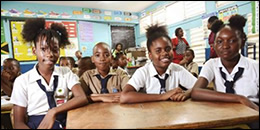 Being homeless before the beginning of the school year and losing family members to the gun were some of the horrendous experiences at least two students at the Allman Town Primary School in Kingston had to overcome as they prepared for the Grade Six Achievement Test (GSAT).
That they did as both earned places at the school that was their first choice.
Vanessa Hanson was one of those students. She shared that she conquered the hurdles, receiving a 92 per cent average, and will be moving on to the Wolmer’s Girls’ School in Kingston.
“I had a fire June 28 last year, and it was very sad. We ended up being homeless, and we had to go back to St Thomas to stay with my auntie. My mommy was trying to find somewhere for us to go, and luckily, she got somewhere in Kingston,” Hanson told The Gleaner. “My grades fell, but my teacher pushed me. I also didn’t expect to get my first choice because I had challenges with communication task. I thought I had failed it.”
She got 86 per cent in mathematics, 88 per cent for science, 93 per cent in social studies, 93 per cent in language arts, and 100 per cent in communication task.
Pain of losing father couldn’t stop Mikayla
Mikayla Reid, whose father was shot and killed at the beginning of the school year, was successful in the Grade Six Achievement Test after gaining an average of 89.75 per cent. She was placed at her first choice as she gained a place at the St Andrew High School for Girls.
“He (father) was always there. He didn’t live where we lived, but he would be at my house every single day,” recalled the Allman Town Primary student. “It was hard because my mother started to have financial challenges, and I used to think that my teacher didn’t like me because she was always on my back. But at the end of the day, I really found out that it was to motivate me.”
Reid added, “Math was very challenging. Most of the time I had to ask my friend to help me. Mommy would get home very late at nights because she worked at a call centre, so I had to study by myself, with no one to help me, really.”
Her scores were 87 per cent in mathematics, 95 per cent in science, 88 per cent in social studies, 89 in language arts, and 100 per cent in communication task.
Read more stories of inspiration and challenge at mycaribbeanscoop.com
Instructions for creating a Week of Prayer for Christian Unity paper prayer chain
Select your paper in as many colours and styles as you like. You can use newspaper or magazine pages. Pick a size for your chain loops and cut the paper into halves or quarters.
Double the paper several times until you have folded it into the width you want for your paper chain. Unfold the paper and cut along the folds to make your paper strips.
Write the name of a church or Christian community on each piece of paper, each link of the chain.
Begin with one chain link. Add a touch of craft glue to the end of a strip and loop the opposite end around. Place the ends together to create a ring. Pray for the church named on that link as you stick the ends together.
Loop another strip through the link and join it in the same fashion.
Pray for each congregation as you link the pieces of paper together and pray for Christian unity. Pray for healing of the wounds of division within and between churches.
Repeat until you have created your paper chain. Allow your links to dry before you hang your chain.
Pray also for the chains of enslavement left by the legacy of colonisation in the Caribbean would be broken.


