Each day during the Week of Prayer for Christian Unity, we provide a starting point, reflection, questions and a prayer based on the theme. Here you can turn your reflections into action with our Go and Do points.
Day 1

Photo: Christian Aid/ Andrew Testa
Global
Be inspired to unity by the Churches of South Sudan and their work for reconciliation.
Since 2013, South Sudan has collapsed into civil war, with widespread insecurity. Tens of thousands of people have been killed, and millions are displaced and in need of humanitarian support.
The South Sudan Council of Churches (SSCC) demonstrates the prophetic witness of a group of religious leaders working out a shared strategy for peace and providing the infrastructure to support it.
The churches, which like the rest of South Sudan, had been deeply affected, traumatised and, in some local areas, divided by the 2013 war, have sought to create reconciliation among themselves as well as others.
The SSCC’s key messages around peace and justice, and the authentic processes of representation it has sought to lead, continue to play an important role in the search for peace with justice in South Sudan.
The decision to give the SSCC a central role in national level negotiations was a recognition of the limitations of formal, inter-governmental diplomacy. But it was also a recognition of the SSCC’s unique strengths – a combination of moral authority and dense connectedness with communities on both sides of the front lines.
When South Sudan is divided into ‘government’ and ‘rebel’ territory, the church retains the capacity to carry out its activities across the country, just as the military and political leaders lose that capacity.
Read more about the lessons in peacebuilding from South Sudan.
Local
How might the churches in your area dialogue around the issues affecting your wider community?
Personal
Seek reconciliation for a broken relationship in your life.
Day 2

Photo: Christian Aid. Flood damaged villages in Madhubani District, Bihar State, India.
Global
Take action by adding your voice to the call to address the climate emergency.
The world’s poorest people have long been living with the impacts of climate breakdown. Families torn apart by disaster, crops ruined by drought, houses lost to rising seas. For many of our friends and neighbours around the world, further inaction is a matter of life and death.
But this year is also a moment of urgent opportunity. Spurred on by the actions of our friends on the frontline of a changing climate and a generation of school strikers, people are finally waking up to the severity of the crisis. We can still fight climate breakdown, and we can do it in a way that will also tackle inequality and restore creation.
But only if we seize this moment and build a movement to sustain it.
Over 2020, nations will set out new ambitions under the UN Convention on Biological Diversity, assess progress towards the UN’s Sustainable Development Goals, and increase their commitments under the Paris Agreement.
At the end of 2020, the UK government will host the UN climate change conference. All eyes will be on the UK and the government will be keen to show its leadership. We have to ensure that leaders make the right choices.
Over 2020 we invite you to sign up to be part of a continuous prayer for the climate.
Prayer that will be informed by and amplify the prophetic voices of our partners. Prayer of confession for the human cause of the climate crisis, prayer of lament for the devastation to communities worst affected, prayer of hope that restoration and renewal is God’s plan for the planet. Prayer that will bring transformation.
We hope to have participants from all over the world take part in this continuous prayer and that it will be a means of motivation, encouragement and inspiration to sustain us in the struggle for justice. Joining together as prayerful people around the world, we will bow our heads and lift our voices to build a better world.
Between two important UN climate conferences at the end of 2019 and 2020, we will fill every minute of every day with prayer for a world where everyone can flourish, and creation can breathe easy again.
Encourage the churches in your community to cover a day or half day, and start planning a prayer and action event.
Local
Are your churches involved in the eco-church / eco-congregation awards?
Personal
Individual actions on reducing carbon are not enough to make the difference but together they add up.
Day 3
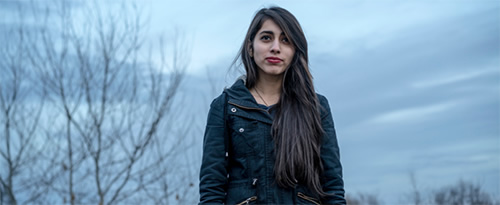
Photo: Christian Aid/Andrew Testa
Global
Read and respond to the stories of perilous journeys by sea.
Today, 244 million people are on the move as international migrants. Of that number over 65 million people have been forced to move; and although 40.8 million of those forced migrants are still living within their own country they have had to leave the place they know as home. The overwhelming majority of those seeking refuge outside their country of origin are hosted in developing countries. Almost all are facing long term displacement. This movement of people is a ‘transnational revolution that is reshaping societies and politics around the globe.’ Even though the camera lens of the media has largely moved away from the migration of people into Europe, the phenomenon of migration preceded, exceeded and succeeded that geographical context.
Shakila Mosanafi, 17, fled Iraq with her parents and siblings and is now living in Bujanovac refugee camp in Serbia, near the Kosovo border. The family are originally from Iran and they fled to Iraq, due to her father’s political ties, when Shakila was 2 years old . They had a good life in Iraq. Shakila and her siblings went to school and her father worked in the family shop. But they remained refugees and didn’t have passports. Realistically they didn’t have a future. On 27 September 2016, Shakila came home from school to find her parents packing suitcases and they left straight away. They travelled through Turkey, then to Greece in a cramped boat, then to Athens where they stayed in a smuggler’s house for 14 days. They left there on foot, setting out on an odyssey which would take them to Albania, Montenegro and finally to Belgrade, where they squatted in the barracks for four days before they were sent to Presevo camp. Shortly afterwards, they were sent to Bujanovac camp. There Shakila works as a translator in the camp to help other refugees communicate.
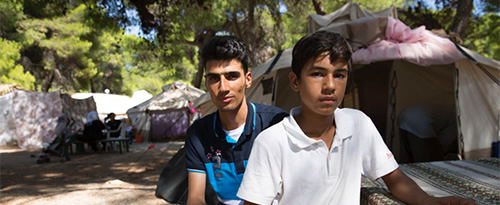
Photo: Christian Aid
Faraidoon and Farzad arrived in Greece alone. They do not know where their parents or other siblings are; they were lost in Afghanistan. Faraidoon almost lost his brother, Farzad, when he fell overboard on the journey across the Aegean Sea. Before they left Afghanistan, Faraidoon was studying engineering and Farzad was still in school. Another family in the camp have taken Faraidoon and Farzad into their temporary home in Agios Andreas.
(Source: Becoming Human Together)
Explore how the churches are responding to the refugee crisis for practical actions and more resources.
Local
Provide welcome and hospitality for those recently arrived into the UK and Ireland.
Personal
Reflecting on your own journey, how might you assist others on journeying today?
Day 4
Global
Be inspired by those who show much resilience in the face of the storm.
Watch and listen to Vilia’s story and consider how you can support those who are facing increasing storms, droughts and floods as a result of a changing climate.
Local
Set up a local group from your churches and community who commit to a deeper listening to one another.
Personal
Spend time with the people or in the place that give you most hope.
Day 5
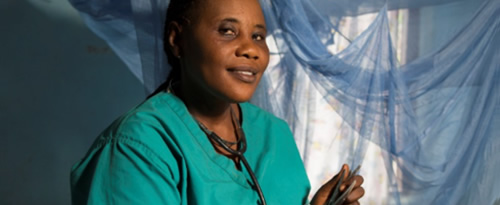
Photo: Christian Aid/ Judith Lassie
Global
Work for the day when good healthcare is available for all.
Nurse Judith Lassie provides compassion and care to the many mums and babies who come to her health clinic in Sawula village in Sierra Leone – but she needs more help.
The health clinic where Judith works is inadequate. It is only the size of a small bedroom, there are no lights and the ceiling leaks. This means mums and babies aren’t getting the healthcare they need.
Christian Aid are working with the local community and partner RADA to build a bigger and better clinic.
When Judith first came to Sawula village, she saw how mums were in desperate need of medical care. But thanks to her strong faith and great love, she’s turning things around.
‘I’ve experienced bad things before,’ Judith tells us, ‘so I know it is very, very heart-breaking when somebody delivers and the child dies.’
It is for this reason that Judith works around the clock to meet the needs of mums and young children who come to the health clinic.
Find out more and support Christian Aid’s work to provide accessible healthcare for all.
Local
Hold a bring and share meal together with the churches in your area where you have a conversation about what Eucharist/Communion/Lord’s Supper means to each church.
Personal
Visit, send a card or call someone who is currently unwell that you know.
Day 6

Photo: ACT Alliance/ Paul Jeffrey
Global
Find out about the united work of the Act Alliance responding to poverty and injustice across the world.
The Act Alliance is the largest coalition of Protestant and Orthodox churches and church-related organisations engaged in humanitarian, development and advocacy work in the world, consisting of 151 members working together in over 125 countries to create positive and sustainable change in the lives of poor and marginalised people regardless of their religion, politics, gender, sexual orientation, race or nationality in keeping with the highest international codes and standards.
ACT Alliance is deeply rooted in the communities it serves. It has earned the trust and respect of local people long before large international interventions scale up, and remains steadfast in its grassroots commitments for many years after world attention has shifted elsewhere.
The photo above shows children at play in one of several child friendly spaces run by the Lutheran World Federation, a member of the ACT Alliance in the Ajuong Thok Refugee Camp in South Sudan. The camp, in northern Unity State, hosts thousands of refugees from the Nuba mountains, located across the nearby border with Sudan. The ACT Alliance provides a variety of services in the camp.
Every day, across the world the ACT Alliance is on the front lines:
- addressing systemic poverty
- supporting survivors of disasters, wars and conflicts
- training rural communities in sustainable agricultural techniques
- helping people adapt to environmental change,
- and influencing governments and other key decision makers to safeguard citizens’ human rights
Visit the ACT Alliance website to find out more.
Local
How do we as churches begin or go deeper into a meaningful conversation with the voices we find difficult in society? What can we learn from these voices? Discuss together.
Personal
How might you show unusual kindness to someone in your community today?
Day 7

Photo: Christian Aid/ Chris Roche
Global
Find inspiration from stories of inclusion and overcoming prejudice in India.
Kasthuri is 22 years of age and mother of Mathi, who is 6 years old. They live in Virudhunagar District, Tamil Nadu, India
Harvest time is coming. Five women chat and laugh as they tend rows of organic tomato plants, which are already loving the hot sunshine.
Kasthuri’s life wasn’t always like this. Like her friends, she was born into India’s underclass; as a Dalit, she knows what it feels like to be discriminated against and alone.
She survived because someone had faith in her. Selvi is from a different caste, but she gave Kasthuri what she needed most – a home to raise her son, Mathi. ‘Normally, someone from her community wouldn’t even hand a cup of water to a Dalit person’ says Kasthuri. Fortunately, Selvi is determined to change the world around her.
The EcoVeg project that Kasturi is part of is also breaking barriers. It supports Kasthuri and her women’s farming collective with agricultural and business skills, and gets them a fair price for their crop.
For the first time, everyone has a sense of control over their lives. ‘Alone as a woman, I couldn’t do this’ says Kasthuri, ‘but together, we can be successful. I have no words to explain how happy I am to be here with my son.’
Local
How are you as churches working with those on the fringes of society? Find out how you could you be supported to do more.
Personal
Take steps to tackle prejudice or exclusion in your life and community.
Day 8
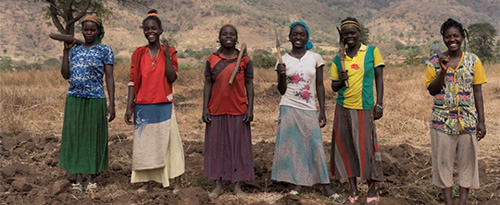
Photo: Christian Aid/ Matt Gonzalez-Noda
Global
Find out how the generosity of churches has made such a difference to communities across the world through the work of Christian Aid.
Christian Aid’s work in Africa includes strengthening peace-building in South Sudan, promoting resilient farming in Kenya and challenging inequality in Sierra Leone.
In Asia, our programmes include those which promote women’s rights in Afghanistan, helped rebuild lives after the Philippines typhoon, and ensure people can access the services they need in Bangladesh.
In Latin America and the Caribbean, we have helped promote gender justice in Brazil and peace-building in Colombia, and support marginalised communities to earn a living in Central America.
Our work in the Middle East and North Africa includes defending people’s rights in Israel and the occupied Palestinian territory, protecting women at risk of violence in Iraq and providing humanitarian assistance to refugees in Lebanon.
Thank you for being part of making this incredible change happen across the world.
Find out more about our new approach and way of working in the Christian Aid global strategy, Standing Together.
Local
Identify your needs as a church or church(es) and consider who you could approach to help you fulfil those needs.
Personal
Ask someone to help you with an outstanding task or need you have.


