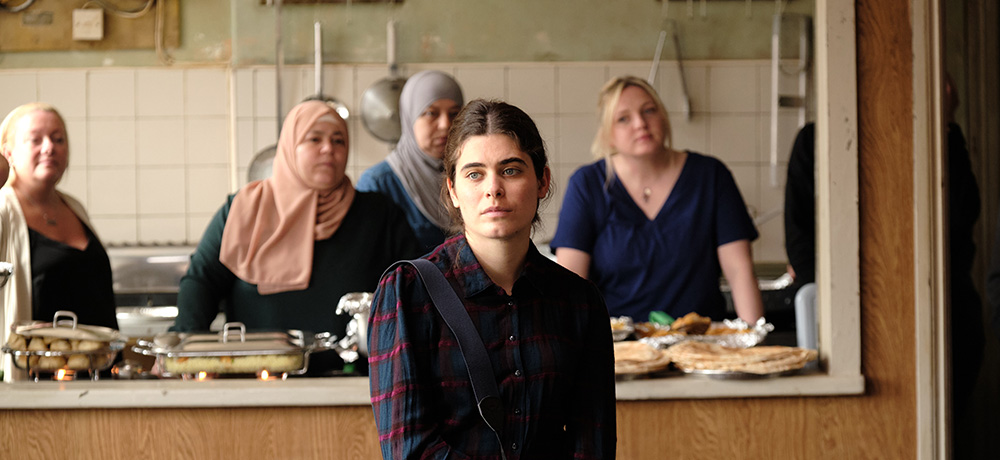
Yari, a young Syrian woman, in the film ‘The Old Oak’.
* Now streaming on Netflix – March 2024 *
When do so-called ‘legitimate concerns’ over the location and accommodation of asylum seekers and refugees, spill over into what can be described as racist attitudes or behaviours? That is one of the themes in the new Ken Loach film, The Old Oak, which is set in 2016, and explores how a fictional, former mining village in northern England responds to the arrival of Syrian refugees.
With the exception of a handful of residents, all the inhabitants in this virtually all-white village appear hostile toward the Syrians. Their grouse is a combination of not being pre-warned about these newcomers, and the council not appearing to care about the effects of this sudden influx on the poverty-stricken village; in short, there has been no (community) impact assessment. At first sight, such concerns appear bona fide. However, what is impossible to justify is the way the local residents articulate their worries, and then put them into play. It is noteworthy that they do not take to task anyone from the ‘body’ that made the decision in the first place; all their fire is turned on the hapless new arrivals; people who no doubt faced real trauma while fleeing their homeland. (Such a scenario reminds me of the Bible verse from Amos 5:19 – ‘It will be as though a man fled from a lion only to meet a bear…’.) Equally, the locals all too easily lapse into language and use tropes that are crude stereotypes at best, and downright racist at worst. The Syrians are invariably described in racist terms, and declared to be potential dangers to the public (would-be terrorists). The irony is that the locals do not believe that their language or behaviour is racist or offensive. Indeed, they even say they are ‘not racists’ and are concerned that ‘outside racist agitators’ may come into their village to stir up real trouble!
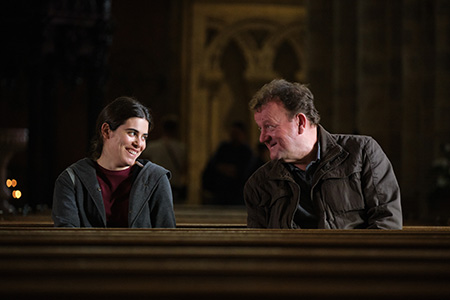
Yari and TJ Bannatyne, the pub landlord, in ‘The Old Oak’.
The film’s heroes, and the village’s moral compass are two locals: TJ Bannatyne, landlord of the eponymous pub, The Old Oak, and Laura, another local resident who helps the Syrians to resettle in the village. They are helped by Yari, a young Syrian woman with a penchant for photography, who now lives with her mother and younger, school-age siblings in one of the tiny houses in the village. Together, they seek to break down barriers, dispel misconceptions and challenge stereotypes through encounters. They agree that food is the best medium to bring communities together, and they fix up the rundown room at the back of the pub, and invite Syrian families and hard-pressed local ones to have meals together. While there is some resistance at first, most warm to the idea, and help with the repairs to the building, and assist with donations of food and cooking equipment. On one particular occasion, they all enjoy an afternoon meal together, and then a photographic slide show which mixes old photographs from the village’s mining heyday with contemporary photos taken by Yari of Syrian families and locals. Two Syrian men then show the villagers an amazing modern coat of arms they have made for the village, which fuses the old with the new, and contains certain English and Arabic phrases.
As this is a Ken Loach film, one should not be surprised to know that there is no Walt Disney-like ending to proceedings. However, one of the things that the film tells us is that it is ‘best practice’ to create opportunities for communities to encounter and engage with one another. It is only through ‘meetings’ that we can start to build relationships.
What the film also illustrates is that there is a lot of ignorance regarding asylum and refugee matters. In one scene from the film, locals moan that ‘they don’t house refugees in rich areas’. The truth is that they do; Westminster in London is arguably the richest area in the United Kingdom, yet it still has its share of refugees; it’s just that they are housed in poor accommodation – think of Grenfell Tower!
In the film we see that the village is poor, and that most of the residents are jobless – as a result of the coal mine closing. This would be a community that would be prime for ‘levelling up’. Yet the local residents appear to turn their ire on those who are equally poor and powerless, rather than the politicians of various political hues who have failed them over decades. As TJ, the pub landlord points out in the film: ‘The villagers were poor long before the Syrians arrived.’
In summing up, I would argue that while the subject matter is bleak, this film is very much about hope, and the importance of not losing hope despite the despair that is all around. The Syrians are fleeing a desperate situation in the hope of starting a new life in a new country. They arrive in a gloomy village filled with desperate people who have little hope, and they subsequently struggle to hold onto their hope in their new surroundings. However, one sees that hope prevails in the efforts of Yari, TJ and Laura, who are also faced with their own challenges, but encourage others to see the best in each other and rise above petty ignorance, small-mindedness and prejudice.
There is little doubt that this film makes uncomfortable viewing for a number of reasons. One could argue that any film focusing on refugees or those seeking asylum should do this, as there is invariably tragedy, loss, suffering and pain involved in any effort to flee conflict, persecution and danger. Yet, the film also has its moments of epiphany, leaving the viewer with a sense that change can occur in some people, if they are prepared to be more reflective, and are willing to move beyond comfort zones that are enclosed by walls of prejudice.
Richard Reddie, Director of Justice and Inclusion, Churches Together in Britain and Ireland


