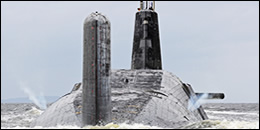
Photo: crown copyright 2012
Churches and Christian organisations including the World Council of Churches (WCC), Church of Scotland, Quakers in Britain and the Joint Public Issues Team (JPIT) have welcomed the adoption of a United Nations (UN) treaty to ban nuclear weapons.
The treaty was adopted by a vote of 122 in favour and one against (Netherlands), with one abstention (Singapore), although the current 9 nuclear weapons states, including the UK, did not take part in the negotiations. The UK, US and France have issued a joint statement saying ‘we do not intend to sign, ratify or ever become party to it. Therefore, there will be no change in the legal obligations on our countries with respect to nuclear weapons.’
Responding to the statement, Elayne Whyte Gómez who served as the President of the conference that negotiated the treaty, compared the situation to when the Treaty on the Non-Proliferation of Nuclear Weapons (NPT) was adopted decades ago. In the beginning, it was unimaginable that those states would be parties to the NPT, she commented ‘but the world changes and the circumstances change.’
‘While there is much more that needs to be done before we can rid the world of nuclear weapons, this represents a significant step forward and will make the possession of these weapons morally and practically more difficult’, said Rev Dr Richard Frazer, convener of the Church of Scotland‘s Church and Society Council.
Quakers in Britain has been an observer at the UN in New York. Tim Wallis, Peace and Disarmament Programme Manager for Quakers in Britain, commented ‘this is an imperfect treaty, but it is hugely significant as a step towards stigmatising and de-legitimising these weapons. And it will certainly go down in history as one of the most important nuclear disarmament treaties of all time.’
‘This treaty will help to tarnish highly distasteful and dangerous rhetoric of the type that we saw in the recent General Election campaign, where government ministers and others talked of using the UK’s nuclear weapons in a first strike capacity. But more crucially because it makes clear that the majority of the world’s states accept the very solid legal grounds that “any use of nuclear weapons would be contrary to the rules of international law applicable in armed conflict, in particular the principles and rules of international humanitarian law”’, said Steve Hucklesby of the Joint Public Issues Team.
“Churches now have a fine opportunity to help with the next step,” said Rev Dr Olav Fykse Tveit, World Council of Churches general secretary. “We can all urge our governments to sign and ratify the treaty and then to see that it is implemented”.
A resource has been produced for church members by the Baptist Union, the Church of Scotland, the Methodist Church and the United Reform Church that includes suggestions for how people might take forward this issue with their MPs.


