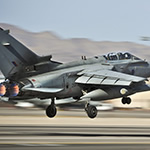
Photo: © Crown Copyright 2013
Churches in Britain issued statements relating to extending military action to Syria prior to the UK Parliament voting for air strikes.
Cardinal Vincent Nichols of the Catholic Church in England and Wales on 2 December 2015 released a statement on action to stop ISIS in Iraq and Syria.
‘Effective action is necessary to stop the grave harm being inflicted by ISIS on civilians. While indiscriminate violence is never justifiable, specific use of force to protect the vulnerable is defensible, if it is combined with sustained diplomatic and humanitarian efforts. As Pope Francis has said: where there is unjust aggression, it is licit to stop the aggressor.’
In the House of Lords on 2 December 2015, the Archbishop of Canterbury, Justin Welby, said:
‘Our bombing action plays into the expectation of ISIL and other jihadist groups in the region, springing from their apocalyptic theology. The totality of our actions must subvert that false narrative, because by itself it will not work.
‘If we act only against ISIL, globally, and only in the way proposed so far, we will strengthen their resolve, increase their recruitment and encourage their sympathisers. Without a far more comprehensive approach we confirm their dreadful belief that what they are doing is the will of God. ‘
His full statement is on Facebook.
In backing the Church of England General Synod’s motion to help refugees on 25 November 2015, Justin Welby said that calling for the establishment of safe and legal routes for refugees to places of safety ‘essentially commits us to the use of armed force overseas’. The whole General Synod debate is available on YouTube.
The Baptist Union of Great Britain, Church of Scotland, Methodist Church in Britain and the United Reformed Church also released a joint statement on military action in Syria on 2 December 2015.
The churches say they are ‘convinced that Daesh can only be defeated through a comprehensive economic, diplomatic and security strategy that has the involvement of all partners in the region and the full support of the UN Security Council’ and that ‘aerial bombing is unlikely to have a decisive role in defeating Daesh and that even the use of precision weaponry is likely to cause civilian casualties and trauma within communities’.
Read the full statement on the Joint Public Issues Team website.
The Church of Scotland separately has warned that launching air strikes on Syria will ‘make things worse for people in that country, not better’.
The Most Rev David Chillingworth, Primus of the Scottish Episcopal Church, says ‘it is likely that a bombing campaign will simply further escalate the violence and fail to challenge the heart of the dreadful ideology which makes attacks like those in Paris and other places possible.’ See the Scottish Episcopal Church website for the full statement.
The Archbishop of Wales is urging politicians to oppose UK air strikes arguing that there is no moral case for bombing Syria.
In an Advent message, the President of the Union of Welsh Independents has called on MPs to reject a Commons motion to bomb Syria. See the Union of Welsh Independents website.
The Quakers in Britain have stated that they oppose military action, consistent with their belief that killing is wrong. Read the full statement on the Quakers in Britain website.


