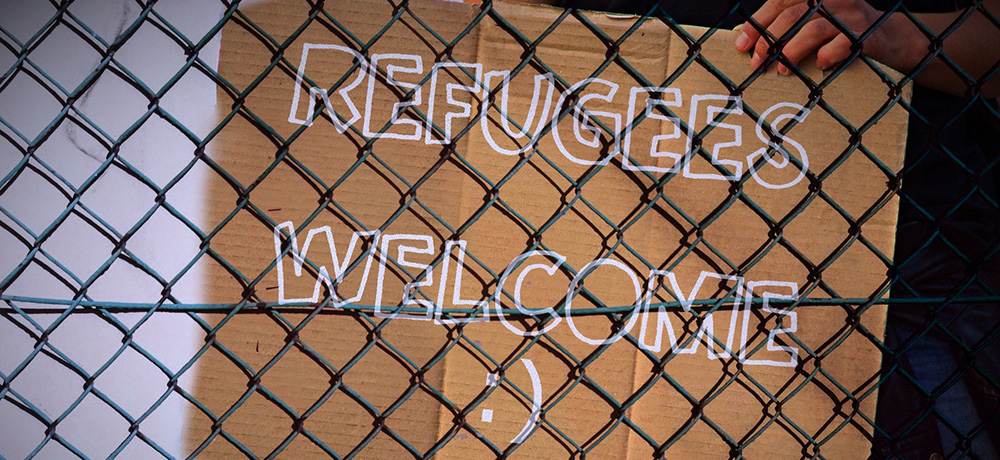
In the Bible, the most frequently repeated ethical requirement is to “also love the stranger as yourself”.
This has to be the loudest message of Churches in the world today. Our core mission is to work with partners to build cultures of welcome and hospitality to counter environments of hostility.
Refugees in Afghanistan fleeing conflict, desperately attempting to board aeroplanes about to take off, clinging on, and falling off to their death is a shameful image of our times. These are human beings seeking safety. Refugees seeking sanctuary.
No one chooses to be a refugee. No one wants to leave home. However, dangers to life force people to leave home, familiar faces and surroundings.
The next twenty/thirty years will see huge movements of people as a result of environmental degradation, climate change, famine, war, violence and persecution. It is a sign of our times, it alerts us that something is not right, and requires our most serious attention. Why are people moving? What are the stories of people who leave their countries and cross borders to go somewhere else?
According to the United Nations High Commissioner for Refugees the majority of the world’s refugees are from countries close to conflict. Refugees from Afghanistan illustrate this. They are fleeing war. People flee for safety and security because they are scared, and live through horrors, humiliation, terror and torture. They bear scars and trauma and distress in their bodies and being. One of their greatest pains is to become separated from family.
Most refugees are displaced inside their own countries, or cross the border and go into the neighbouring country. There are refugees, of course, who take longer and more difficult journeys, risking life and costing huge amounts of money. People fleeing danger remain vulnerable and in need for safety and protection. Many lose their lives as they search for safety.
People will continue to travel from many countries and contexts, overcoming obstacles like walls, frontiers, borders, mountains and waters in search of safety and wellbeing.
Long term, this will only stop when nations stop wars, stop making weapons and instead invest in, and ensure everyone has access to equality, inclusion, education, homes, and hospitals, and build peace. Everyone wants to live in safety.
With Britain and the EU closing doors, there are no safe or legal routes for refugees. It is practically impossible to get a Visa in the country of origin to get to the UK “legally” in order to then seek asylum. It creates illegality. Many people run for safety without waiting in queues for biometrics and travel documents, and some of them arrive in the UK and apply for asylum. They need a warm welcome too. Between 2008 and 2019 the UK deported 15,755 people to Afghanistan according to Eurostat.
The current UK Nationality and Borders Bill creates a two-tier system that treats people as deserving and not deserving refugees. It criminalises people from Afghanistan and other countries seeking sanctuary here outside very restricted official schemes.
Organisations working with refugees and those seeking sanctuary from war and violence have uniformly and consistently expressed strong opposition to the Bill. This opposition will be sustained. It is the duty of governments to help refugees in need of shelter and sanctuary, and to provide legal routes for all refugees to travel safely.
Every day many people set out to cross whatever barrier is in the way to find safety and a better life. When people are deprived of their homes, their families, and familiar surroundings, they will be grateful for friendship, a smile, welcome, hospitality and safety.
The best response at the local level is to work hard to build cultures of welcome, hospitality and sanctuary, to express love and kindness. We can all be agents of change, and work with others to make life better. This work will help us to connect local stories with global stories.
The way ahead is to widen and deepen relationships across different cultures, creeds, colours and identities, to end hatred, and together to build cultures where all are welcome, valued, belong equally together and have sanctuary and are safe. In words of scripture, together we can seek the welfare of the city for in its welfare lies the welfare of all. We can be united in building hospitality. All people are human beings with names, stories and deep relationships. All want empathy more than sympathy, respect more than pity.
We belong to each other. As the old Celtic proverb reminds us: “it is in the shelter of each other that the people live”. We all want the best for ourselves. We can work together to ensure the best for all.
Consider working to make your city, town, village, church, school, college, university, club or place of work, a sanctuary committed to building cultures of welcome and hospitality, especially for those in greatest need and danger. Primarily, this is a commitment to helping make the most vulnerable people safe from harm.
Church of Sanctuary is part of the City of Sanctuary network, and is supported by CTBI. It is a call to a prophetic Christian witness and expression of hospitality as a clear challenge to hostility. The hope is that churches will become places for all and proud to offer sanctuary to people fleeing violence and persecution.
In a Church of Sanctuary all members of the congregation work together to:
- Learn about and understand real life experiences and stories of people seeking sanctuary, and help others to work from facts not fiction.
- Embed the values and cultures of welcome, hospitality and safety, and use these to support people seeking sanctuary, and include them in your activities.
- Share with pride your vision, commitment and achievements, and let others know about the positive contributions of refugees to society and the benefits of welcoming cultures.
How we all relate to each other, and in particular to people seeking sanctuary and safety will be central to humanity. How we all treat those who are in greatest need for love and safety will be the measure by which we shall judge personal, national and international morality and spirituality.
Inderjit Bhogal


