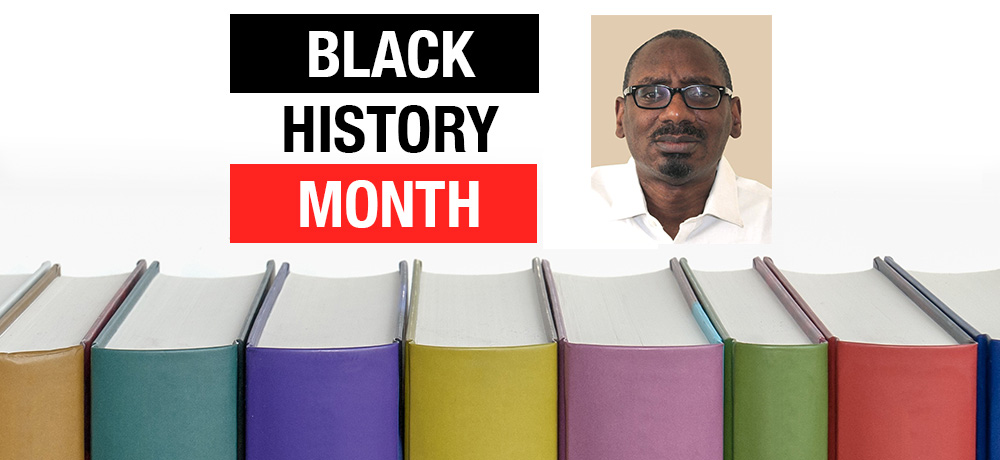
Richard Reddie, Director of Justice and Inclusion at Churches Together in Britain and Ireland (CTBI), reflects on why Christians should celebrate Black History Month.
I have always been an avid supporter of Black History Month (BHM), which I consider both necessary and relevant in Britain. There is little doubt that since its inception almost four decades ago, countless numbers have been informed of, and inspired by, the vast (and ongoing) contributions made by people of African origin to these shores.
It is my contention that BHM has always presented Black Christians in particular with an open goal to propagate their faith. Back in the early days when BHM largely revolved around the teaching of African enslavement, and the life of Revd Dr Martin Luther King Jr (and the US civil rights movement), those within Black Majority Churches (BMCs) could wax lyrical about the role Christianity played in ending the Transatlantic Slave Trade – pointing to British-African Christian abolitionists such as Olaudah Equiano, Quobna Ottobah Cugoano and the Sons of Africa movement, as well as the massive Christian dimension to the US Civil Rights struggle.
Equally, Black Christians could use this month-long celebration to highlight the prominence of BMCs, which have transformed the socio-spiritual landscape of Britain and Ireland to demonstrate that they are the real Black ‘success stories’ over the last 70 years. Some of the larger Pentecostal congregations, which began in an individual’s front room over 60 years ago, are now national organisations with churches in every major town and city. If these churches were franchise-styled businesses, rather than places of worship, the pioneers who established them would be considered ‘captains of industry’ and be the recipients of royalty bestowed honours.
History and evidence reveal that in many neighbourhoods and communities, Church leaders, who can count their congregations in the hundreds (and in some cases, the thousands), are the de facto community leaders. History also shows that key figures within the BMCs pioneered many efficacious services that have helped so many within Black communities, such as the Supplementary School movement and the Black Housing Association sectors. Equally, BMCs have been behind such initiatives as the Street Pastors programme, the Pentecostal Credit Union, and the Excell3 national educational charity that transforms young people’s lives through education, training, and development.
Despite these sterling efforts, there are no shortage of detractors who argue that BMCs ought to be doing more, given their reach and influence, to alleviate various phenomena impacting Black communities. The common criticism is that they should be more engaged in the work to tackle serious youth violence, making interventions in asylum and immigration matters, addressing the crisis in mental health, and standing by those who are incarcerated.
While BHM presents the BMCs with an open goal, a good number of Black Christians are still reluctant to engage in this celebration, and many Christians of all ethnicities are still unconvinced of its importance. I am often invited onto Christian radio stations in October to talk about the importance of BHM, and the first question I invariably get asked is, ‘Why do we have BHM?’ or ‘What is there to celebrate?’
I am convinced that some Black Christians struggle to celebrate the achievements of those who are of other faiths and none. It is as if they have some form of faith-related ‘litmus test’ or criteria that must be met before they are fully endorsed. As such, figures such as Claudia Jones, Linton Kwesi Johnson, Menelik Shabazz, Bernie Grant MP, George Padmore, Olive Morris, Len Kwesi Garrison, Darcus Howe, William Cuffay, Diane Abbott, Sonia Boyce, Dame Jocelyn Barrow, and others – men and women of other faiths and none who believed that their religious beliefs, political ideas or rational thoughts inspired their involvement in the struggle for Black freedom and equality, do not get the props they deserve.
This Black Christian conundrum first took root when BHM tended to focus on the aforementioned US civil rights movement, in which Dr King was often compared to his Muslim counterpart, the articulate, firebrand champion of Black rights and self-determination, Malcolm X. Christians were not only wary of the latter’s faith, but also critical of his stinging denunciations of Dr King as “Reverend Chickenwing” – an Uncle Tom figure who was selling out his fellow African Americans for the proverbial 30 pieces of silver.
Likewise, a good number of Black British Christian households still refuse to play the music of Jamaican-born Bob Marley, whose songs eulogised the Rastafari faith, and whose rebel philosophy critiqued western (Christian) values, and extolled the usage of ganja as a sacramental rite. Marley’s message of Black unity and African pride proved very persuasive on both sides of the Atlantic, and during the height of his fame, many Black British youths abandoned the Church to follow the Rastafari faith.
Black Christians have much to be proud of, but they should also be cognisant and accepting of the equally outstanding endeavours of all their Black brothers and sisters, who are also made in the image of the God they worship. In my opinion, any failure to respond to an individual because he or she was/is not a Christian is both myopic and unhelpful.


