School Assemblies
Invite responses from pupils to encourage empathy and self-awareness. You could use one, more or all of these sets of questions to suit to your group, depending on the time available.
What would you do to welcome someone? (All schools)
This activity might be particularly useful if the school is likely to receive refugees in the near future and wants to think about becoming a welcoming community.
Explain that refugees are people who have been forced to leave their homes and are trying to rebuild their lives in a new country.
If a refugee family moved into your street / school / church / community, what do you think they will be feeling? If it were you, how would you like to be welcomed?
Ideas could include conversations around:
- Making friends
- Not bullying them because of their experiences, language skills or accent; what if it was you?
- Challenging racism
- Inviting them round for a meal
- Offering extra help
- Being patient as they try to learn a new language
- How to help them fit in to life (where to catch a bus, what time the shop is open)
- Being sensitive that they have had a difficult experience and might not want to tell people about it.
What would you take? (Primary schools)
Bring a selection of personal and essential items, and some luxuries. Ideas might include: first aid kit, water bottle, passport, phone and charger, photographs of family, a map, food, a Bible, a pillow, a teddy bear, a toy, a purse.
Ask the pupils, if you had to leave your home in a hurry which one thing would you take with you. You could ask for a volunteer to come up and talk through their choice. Why did you choose it? Was it difficult to choose?
Ask them: How would you feel if you had to leave your home in a hurry? How would you feel if you could never go back?
With thanks to Christian Aid, more ideas and resources are available at:
www.christianaid.org.uk/schools/refugees-assemblies
Where would you go? (Secondary schools)
Ask the pupils, if they were forced to leave their home, where would they go to?
Facilitate a structured discussion which could cover issues such as:
- To a neighbour’s (but what if they had to leave too…)
- To a friend’s (but what if they had to leave too…)
- To family (but what if they had to leave too…)
- To another country – does anyone have family they might go and live with?
- Or friends who live overseas?
- What if you don’t know anyone who lives in another country, where would you go?
- To a country close by so it is easier to get home?
- To a country where they speak your language?
- To a rich country so you can be looked after?
- To a country where they have the same religion or culture?
Explain that most people who are forced to leave their home move from one part of their country to another. When they cross a border they are classed as ‘refugees’ – but most refugees are in countries neighbouring to their country of origin because of connections of family, friends, culture, religion and language. Only around 6% of all the refugees in the world live in Europe – despite it being a very rich place.
You could also ask about how people would travel when they are leaving. Drive? Walk? Bike? What would they do if the roads were closed or patrolled? Walk over rough ground at night? Hitchhike or be a stowaway? Pay a smuggler to get you away?
You could reflect that sometimes people are left in desperate circumstances and have very little choice about what they can do, and will go to extreme and even dangerous lengths to try to get safety.
Youth groups
Poetry writing
In the Eastern world, poetry is considered to be the collective memory of the people to which all contribute, whether rich or poor, born in times of happiness or desperation. The elders tell children stories in verse. Starting in December 2015, a group of boys aged 14-18 who fled to Europe alone from Afghanistan and Iran met regularly with their poetry mentors in Berlin. They composed poems about fear, abandonment and longing. Their stories give rare insight into their experiences living alongside war, why they fled to Germany, and how they see their new neighbours, the Germans.
The results are intensely personal lines that reveal that under the rubble of war, the poetic soul of a centuries-old culture lives on, beautiful and intact, in this young generation. Through poetry they find their voices.
www.thepoetryproject.de
Could your group create a poem collectively, reflecting on the hopes and anxieties?
Everyone needs a safe place
Christian Aid has produced the Safe Place Ludo Game as a youth group activity to introduce some of the important issues raised by refugee emergencies. It is designed to be used as a tool to help children and young people engage with the stories of refugees and the difficult journeys that they make.
www.christianaid.org.uk/schools/safe-place-ludo-game
Group discussion questions
- “The Bible is a piece of migration literature”. What do you think about this? What does it mean for you ?
- Your faith – has it “become sedentary” or is it still “on the move”? What life events have changed your faith?
- What role does your faith play when you travel to a foreign country in order to settle and feel at home?
- Faith and the Bible have migrated through mission, trade and conquest to many countries and cultures. Today, Christians from other parts of the world and different cultures make a ‘return’ migration to Europe. They celebrate services in congregations of different languages and origins. Are we still sisters and brothers in faith?
Run an exhibition to make migration more visible
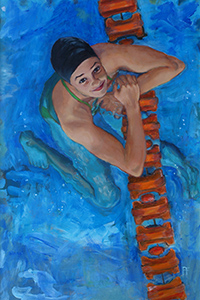 AHeart4Refugees ran exhibitions in churches with pictures by Penny Faux. Maybe your church wants to get involved with something similar.
A team arranged the fencing in a diamond pattern around the tents. They attached the paintings to the fencing with wire and put a map of refugee migration on one of the fences.
The stories that were shown on the paintings were added next to them.
Visitors received a crocheted heart and were encouraged to tether the loose end to the fencing as they started their walk round the exhibition. The hearts unravelled as they went, and could be hung anywhere along the fencing or completely unravelled, as people chose. The resulting heart strings could help people to engage emotionally.
Accompanying the exhibition, churches are encouraged to make it their own. They could invite speakers, run crochet workshops, invite VIPs to a launch evening, get local artists and children to contribute work, run a ‘how many kids in a dinghy challenge’ or become creative in any other way.


